
Quick Answer
A practical guide to building market positioning on customer insight rather than assumption.
Summary
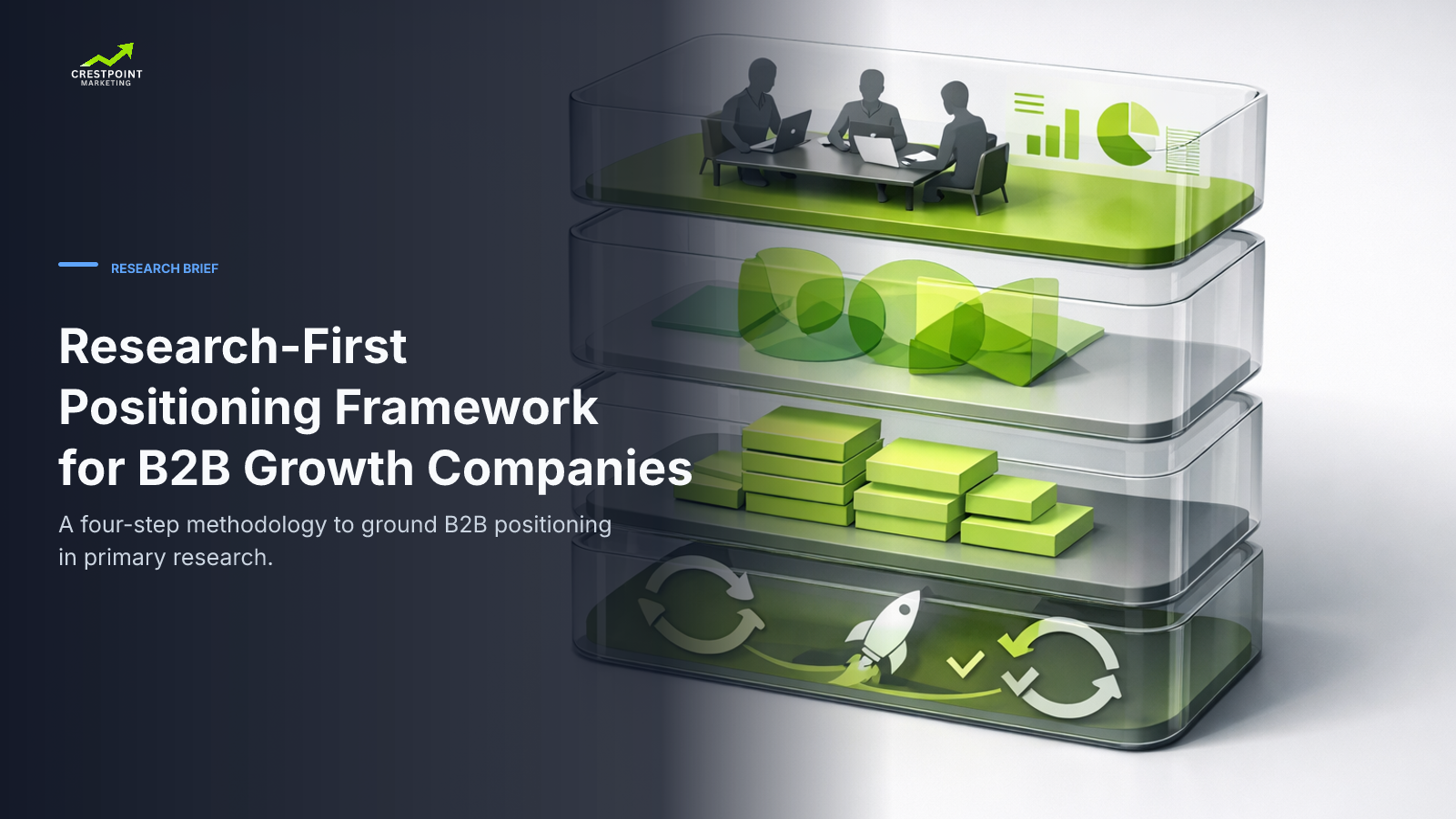
Research-first positioning grounds every messaging decision in direct customer and competitive research before a single campaign dollar is spent. This guide explains how the methodology works, when to use it, and how to diagnose whether your current positioning needs rebuilding. It covers the three-phase research sequence, the role of ideal customer profile definition, why competitive differentiation fails when it focuses on features, and how to choose between structured, internal, and agency-led approaches.
---
What Is Research-First Positioning?
Research-first positioning is a strategic methodology where B2B companies ground their market positioning in direct customer and competitive research before writing a line of messaging or launching a campaign. Rather than starting with internal assumptions about value propositions, it requires structured input from ideal customers, lost deals, and competitive comparisons first.
The output is a positioning foundation - a defined market category, a named ideal customer profile, and differentiated claims - that reflects how buyers actually think, not how internal teams wish they did. For growth-stage B2B companies, this sequence prevents the most common failure mode: executing campaigns on messaging the market doesn't recognize.
---
Key Takeaways
- Defining positioning before campaign execution reduces mid-campaign messaging corrections, which can consume a large portion of a campaign's original timeline.
- Ideal customer profile definition requires at least five to eight structured customer interviews to reveal reliable patterns in buying motivation and objection language.
- Competitive differentiation in B2B markets fails most often because companies compare features rather than buyer outcomes and switching costs.
- Messaging inconsistency across sales, marketing, and product is the leading operational signal that positioning clarity work is incomplete.
- Research-first positioning produces a foundation that holds across sales cycles, content strategy, and paid campaigns without constant rework.
---
Assumption-Led Positioning vs. Research-First Positioning
| Factor | Assumption-Led | Research-First |
|---|---|---|
| Starting point | Internal brainstorm | Customer interviews + win/loss data |
| Time to first message | Fast (days) | Structured (weeks) |
| Message durability | Low - requires frequent revision | High - reflects actual buyer language |
| Sales alignment | Often misaligned | Built into the research process |
| Campaign failure risk | High | Significantly reduced |
| Resource cost over time | Higher (repeated rework) | Lower (fewer mid-cycle corrections) |
Assumption-led positioning reaches market faster but needs constant revision because it reflects what internal teams believe buyers value rather than what buyers actually say. Research-first positioning takes longer to establish but holds across sales conversations, content programs, and paid campaigns without repeated rebuilding.
---
When to Choose Each Approach
Research-first positioning is the better choice when:
- Your sales team delivers different value propositions than your marketing team
- Conversion rates from qualified traffic are declining despite consistent content output
- You're entering a new market segment or launching a product extension
- Your messaging uses category language your top three competitors also use
- You're planning a campaign with meaningful budget at stake
- You've lost deals without a consistent explanation from sales notes
A lighter-touch approach may be acceptable when:
- You're testing a minimum viable message with a very small audience before committing to a full positioning cycle
- You have fewer than 10 customers and no reliable pattern yet exists in win/loss data
- The market is genuinely new and no buyer interviews are achievable before an initial launch
---
How Research-First Positioning Works in Practice
The methodology follows a structured three-phase sequence.
Phase one: positioning discovery. Structured interviews with current customers, recently churned customers, and prospects who chose a competitor surface the language buyers use to describe their problem, the alternatives they considered, and the specific moment they decided to buy. This phase produces three outputs: a revised ideal customer profile based on real buyer patterns, a map of competitive alternatives buyers actually considered, and differentiation claims stated in buyer language rather than product language.
Phase two: messaging architecture. Research outputs translate into a category name, a primary positioning statement, differentiated claims, and proof points. Each element is traceable to a specific research finding. If a claim can't be traced to something at least three buyers said or implied, it gets cut.
Phase three: internal alignment. Sales, marketing, product, and leadership align around the agreed positioning before any campaign or content production begins. This is where most companies skip ahead - completing the research, drafting a document, and moving to content without confirming that sales is prepared to carry the same message in discovery calls.
April Dunford's framework, documented in *Obviously Awesome*, formalized the core problem this approach solves: companies compete in categories they define themselves rather than categories buyers already use to evaluate options. Research-first positioning corrects this by starting with the buyer's frame of reference.
---
Why Messaging Inconsistency Is a Positioning Problem
When marketing content promotes one set of value claims and sales conversations pivot to a different set, most companies treat it as a communication gap. They schedule alignment meetings and share slide decks, assuming the problem is that sales hasn't read the messaging guide.
That's almost never the real issue. Sales teams abandon official messaging when it doesn't resonate in actual buyer conversations - they revert to language that works in the room. That's a signal the research hasn't surfaced what actually moves buyers.
Treat this inconsistency as a diagnostic, not a personnel problem. If sales can't carry the marketing message, the message needs research before it needs enforcement.
---
The Role of Ideal Customer Profile in Positioning Accuracy
A well-defined ideal customer profile isn't a demographics grid. It's a description of the specific buyer who experiences the problem your product solves most acutely, has already tried alternatives and found them inadequate, and is in a position to act. Each condition matters independently.
A company experiencing a problem but satisfied with its current workaround isn't an ideal customer. A company actively unhappy with its solution but not authorized to switch vendors isn't one either. The ICP is the intersection of problem acuity, prior alternative failure, and buying readiness.
Structured interviews with five to eight of your best existing customers - not your largest, but the ones who get the most value and renew or expand - surface shared characteristics that demographic modeling can't capture: the internal trigger that created urgency, the specific failure of the previous solution, and the outcome they were trying to achieve.
For growth-stage B2B companies, ICP definition is the single highest-leverage positioning activity available. It determines which segments receive campaign spend, which industries receive content, and which objection language sales addresses in outreach - get it wrong at the start and that misalignment multiplies across every downstream activity.
---
Competitive Differentiation Beyond Feature Comparison
Most B2B companies approach competitive differentiation by listing features competitors don't have. This fails for two reasons. Competitors observe the same differentiation language and adopt it within a product cycle or two, erasing the claimed distinction. And feature differentiation doesn't match how most B2B buyers actually decide.
B2B purchase decisions - particularly where budgets are constrained and switching costs are real - hinge on switching risk, organizational fit, and trust signals rather than feature grids. A buyer evaluating two vendors with similar capabilities is asking: which one reduces my risk of a failed implementation, which demonstrates it understands my specific context, and which one's failure mode is most recoverable if something goes wrong.
Differentiation that addresses those questions is durable because it's grounded in buyer psychology rather than product specifications. Research surfaces which concern dominates for your specific ICP, so you can build messaging around real decision criteria rather than stated ones.
---
Use Cases by Industry
B2B SaaS: The most common finding from positioning research in this segment is that the company is competing in a category defined by its largest incumbent rather than one where it has a structural advantage. Repositioning into a more specific category with a narrower ICP claim tends to reduce cost-per-lead while improving close rates.
B2B Professional Services: Expertise is assumed rather than differentiated in this market. Research-first positioning identifies the specific buyer context and outcome where the firm's approach produces distinctly better results than generalist alternatives - which then drives content strategy, case study selection, and sales conversation framing.
Industrial and Specialized B2B: Companies preparing for a major tradeshow often discover during positioning work that their event messaging doesn't match the language their best prospects use to describe the problem they're solving. Aligning event materials to research-validated buyer language improves booth conversation quality and post-event follow-up response rates.
Early-Stage B2B Technology: Founders frequently build product-centric homepages that describe what the technology does rather than what problem it solves and for whom. Positioning research conducted before website development produces a site structure grounded in how buyers evaluate the category, not how engineers describe the product.
---
Structured vs. Unstructured vs. Agency-Led Approaches
| Factor | Research-First (Structured) | Internal Assumption-Led | Large Agency-Led |
|---|---|---|---|
| Positioning basis | Direct customer interviews | Internal team brainstorm | Stakeholder workshops |
| ICP definition method | Behavioral patterns from buyer data | Demographic modeling | Category benchmarking |
| Sales alignment built in | Yes | Rarely | Varies | | Revision frequency | Low | High | Moderate to high | | Cost over 12 months | Moderate | Low upfront, high in rework | High, fixed regardless of output |
Structured research-first positioning takes more time to initiate than an internal brainstorm but produces fewer mid-cycle corrections. Large agency-led processes often take longer and carry higher fixed costs without guaranteeing that resulting positioning reflects actual buyer language rather than stakeholder consensus.
---
Expert Insight
One pattern that appears consistently in B2B positioning engagements is the gap between the competitive alternatives companies list internally and the alternatives buyers name in research interviews. Internal teams almost always identify direct product competitors as the primary alternatives. Buyers consistently name spreadsheets, internal processes, or doing nothing as the alternatives they seriously considered. Positioning built against the wrong competitive set produces messaging that wins comparisons against competitors buyers were never actually evaluating.
---
Buyer-Facing Decision Framework
Use these questions to determine whether your current positioning is ready to carry a campaign or needs research first.
1. Can your sales and marketing teams state your primary value claim in the same words? If the answer is no, your positioning hasn't been validated - it's been documented. Research should precede the next execution cycle.
2. Does your messaging describe the problem your buyer experiences, or the product you built? Product-centric language signals that internal assumptions drove positioning. Buyer-centric language - grounded in the words real customers use - is a sign research informed it.
3. Do you know which alternatives your buyers seriously considered before choosing you? If your internal list says "Competitor A and Competitor B" but you've never asked buyers directly, your competitive differentiation may be aimed at the wrong target. The most common finding in positioning research is that buyers considered spreadsheets or doing nothing - not the vendors you named.
4. Can you trace every core claim back to something buyers said? If your positioning document exists but no claim links to a specific interview, win/loss record, or research finding, you're operating on assumption.
5. Are you about to commit budget to a campaign? If yes and you can't answer the first four questions confidently, completing a positioning cycle before launch will cost less than correcting course mid-campaign.
---
Frequently Asked Questions
How do we know if our positioning needs work? The clearest signals are messaging inconsistency between sales and marketing, declining conversion rates from qualified traffic, and sales teams routinely reframing value in conversations rather than carrying the documented message. Any one of these means positioning clarity work should precede the next campaign.
How long does positioning research take? Companies with more complex stakeholder structures or multiple product lines may need additional time for the alignment phase.
Can positioning research be done internally? Internal teams can run positioning research but face two structural limitations: buyers give more candid answers to third-party interviewers, and internal researchers often confirm existing assumptions rather than surface contradicting evidence. External facilitation produces more reliable findings.
When does positioning need to be updated? Revisit positioning when win rates decline without an operational explanation, when a new product extension enters a meaningfully different buyer segment, or when competitive dynamics shift enough that existing differentiation claims are no longer accurate.
Do we need to pause existing campaigns during positioning research? Not necessarily. Existing campaigns can continue while positioning research runs in parallel. The more important threshold is not launching new campaigns or making significant budget commitments to unvalidated messages until the positioning foundation is complete.
What's a realistic timeline for seeing results? Positioning clarity isn't a direct demand generation tactic. Its impact shows up in improved campaign efficiency, higher sales close rates on positioned segments, and reduced messaging rework over time.
---
Sources
Related Resources
---
Start with Positioning Before the Next Campaign
If your team is planning a campaign, a go-to-market motion, or a content program, the most effective first step is confirming that the message you're about to promote reflects what your best buyers actually say - not what your internal team assumes they want to hear. CrestPoint works alongside internal marketing teams to complete positioning clarity work before execution begins, so the research foundation is in place before budget is committed.
Start with a positioning conversation