
Quick Answer
Choose the right external marketing model before you spend another dollar on campaigns.
What Is a B2B Marketing Partner?
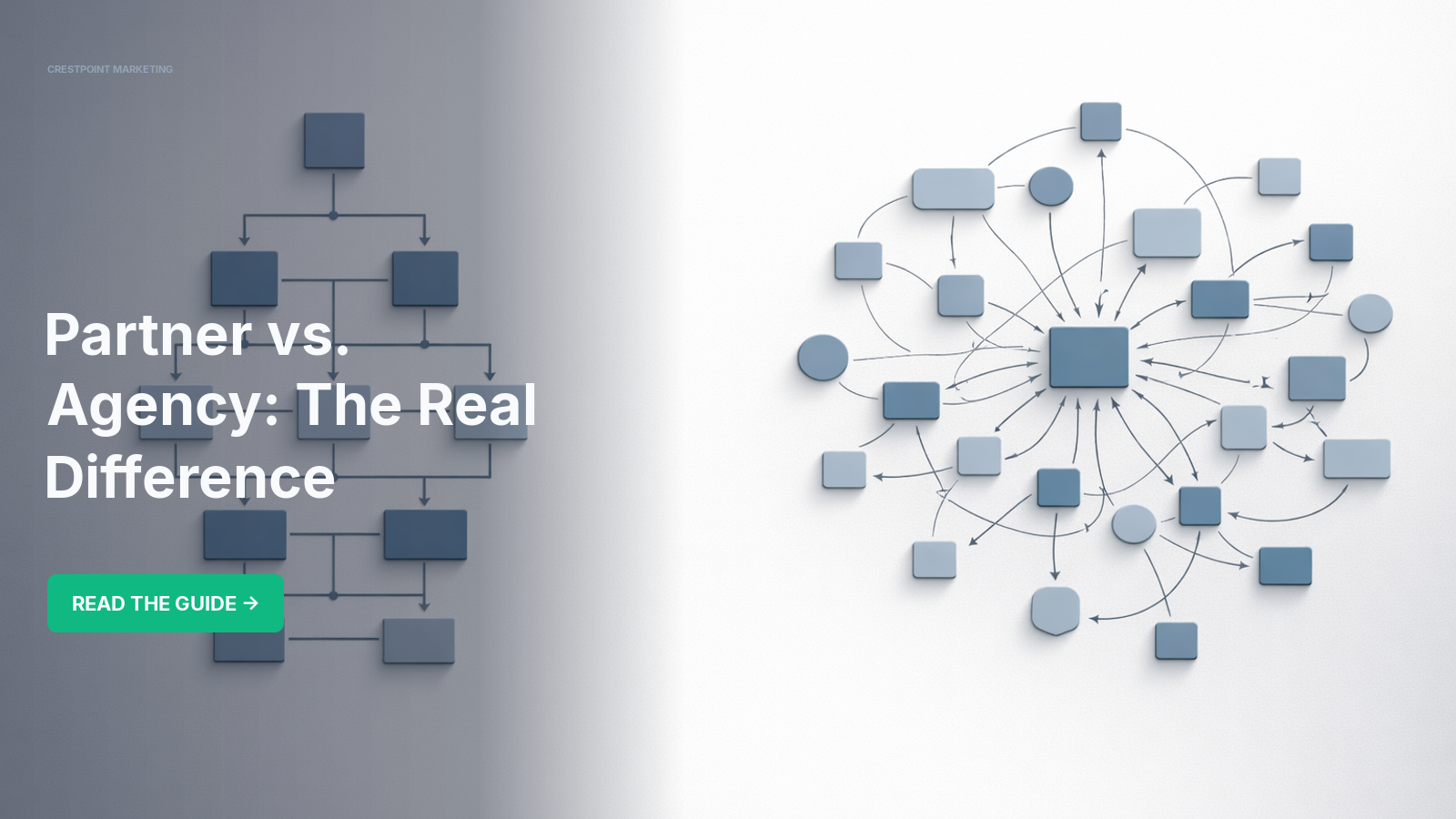
A B2B marketing partner is an external strategic advisor and execution resource that works alongside your internal team on an ongoing basis, typically through a structured retainer. Unlike a traditional agency that delivers scoped outputs and steps away, a marketing partner embeds into your planning cycle, prioritizes positioning research before campaign execution, and stays accountable for strategic direction throughout the engagement.
The model sits between hiring a full-time senior marketer and contracting a project-based agency. That makes it well-suited to lean B2B teams that need structured expert guidance without a large agency's overhead or the unpredictability of freelance support.
---
Key Takeaways
- A B2B marketing partner operates on ongoing retainer engagements, not project deliverables - strategic context accumulates over time rather than resetting with each new vendor contract.
- Lean B2B teams that skip positioning research before content production routinely produce messaging that misrepresents their actual competitive advantage, wasting budget on well-executed but misdirected work.
- The real cost of an execution-only agency often exceeds the sticker price once you add internal management time, messaging corrections, and campaign rebuilds.
- A research-first model gives writers, sales teams, and leadership a shared, documented source of positioning truth - instead of institutional memory that varies by person.
- Growth-stage B2B companies that nail market positioning before scaling content output generate more qualified pipeline because their messaging selects for the right buyers from the start.
---
Marketing Partner vs. Agency at a Glance
| Factor | Marketing Partner | Traditional Agency |
|---|---|---|
| Engagement structure | Ongoing retainer, embedded | Project-based, deliverable-scoped |
| Strategic input | Included, research-driven | Often additional or absent |
| Positioning work | Precedes execution | Rarely included |
| Internal team coordination | Active, collaborative | Minimal, handoff-based |
| Accountability model | Shared strategic outcomes | Deliverable completion |
| Cost predictability | Fixed monthly, defined scope | Variable by project |
A marketing partner prioritizes strategic continuity and research-grounded execution. A traditional agency prioritizes deliverable volume within a defined project scope. For lean teams managing complex B2B sales cycles, the partner model reduces internal burden because strategy and execution stay under one accountable relationship - not split across disconnected vendors.
---
When to Choose a Marketing Partner vs. a Traditional Agency
A marketing partner is usually the better choice when:
- Your team has fewer than three full-time marketers and lacks dedicated bandwidth for strategic planning
- Your positioning is unclear or inconsistent across sales materials, the website, and campaign copy
- You need ongoing content production aligned to a documented market strategy, not one-off deliverables
- You're preparing for a new market segment, product line, or competitive repositioning and need research before execution
- Your last agency engagement produced content that required heavy internal revision or didn't reflect your actual differentiation
- You want a single point of strategic accountability rather than managing separate vendors for research, content, and campaigns
A traditional agency is often the better fit when:
- You have a fully staffed internal strategy team and need execution capacity only
- Your engagement is clearly scoped to one project with a defined end date, such as a website rebuild or a single campaign
- Your positioning and brand standards are established and need no interpretation
- Speed of delivery on a known brief is the primary criterion
---
What Makes a B2B Marketing Partner Different From an Agency
A traditional B2B agency sells outputs: a set number of blog posts per month, a defined batch of ad creative, a completed website. Success means those outputs arrived on time and to spec. Your internal team earns its keep by managing the agency, reviewing deliverables, and maintaining strategic continuity between engagements - work that never shows up on the agency invoice.
A marketing partner inverts that relationship. The partner takes responsibility for strategic direction, which means the first thing a competent partner does is study your market, your competitors, and your buyers before writing a single word of copy. This isn't a luxury for growth-stage companies - it's the mechanism that prevents wasted execution. When a team produces twelve blog posts built on a misunderstood buyer persona, every post compounds the error. When a partner audits positioning first, those twelve posts actually advance the commercial argument the sales team is already making in the field.
The structural difference shows up in governance, too. A traditional agency relationship is transactional: scope in, deliverables out, invoice sent. A partner relationship involves recurring strategic reviews, documented positioning frameworks, campaign performance analysis, and proactive recommendations the client didn't have to request. That ongoing context is what makes the model scalable. A new marketer joining the client's team can onboard in days because the strategic documentation already exists - and a new campaign can launch faster because the positioning brief doesn't need rebuilding from scratch.
---
The Hidden Cost of Execution-Only Vendors
Lean B2B teams are especially vulnerable to a specific false economy: choosing the cheapest execution resource and absorbing the strategic management burden internally. The math looks fine on a spreadsheet. It collapses in practice.
A junior agency coordinator producing content without strategic oversight generates deliverables that require VP-level editing, repositioning, and sometimes complete rewrites. That VP time costs real money, even when it never appears on the marketing budget line. The pattern plays out across B2B technology, professional services, and specialized industrial companies in a predictable way: the marketing manager spends hours briefing vendors and correcting misaligned drafts. The VP of Marketing explains in meetings why the last campaign attracted the wrong leads. The sales director points out that marketing materials don't match what the team says in the field. None of that friction appears on an agency invoice - but all of it represents real organizational cost.
Choosing a B2B marketing partner doesn't eliminate vendor management. It consolidates strategic accountability in a way that cuts total management overhead. When the partner owns positioning research, content strategy, campaign review, and execution guidance under a single retainer, the internal team stops functioning as the strategic layer on top of a disconnected execution vendor. That shift alone often justifies the difference in monthly cost between an execution-only agency and a full partner model.
---
How a Research-First Model Works in Practice
A research-first marketing model begins with market and positioning analysis before any content or campaign work starts. This typically covers the competitive landscape, buyer decision criteria, the client's current messaging across all channels, and the gap between the story the company tells and the story the market actually believes.
For a B2B technology company preparing to launch a new product line, this phase might reveal that the existing website positions the company as a platform vendor when buyers consistently categorize it as a workflow tool. That distinction determines which search terms convert, which case studies belong on the site, and which objections the sales team faces late in a deal. Without surfacing that gap first, every content asset produced reinforces a positioning error that the sales team is already working around.
CrestPoint Marketing builds this research phase into every strategic partnership engagement, treating it as a prerequisite for any content production, campaign planning, or advertising review. The output is a documented positioning framework that all subsequent execution references - so content created in month six stays strategically aligned with content created in month one.
The research-first model also benefits lean teams operationally. When positioning is documented and shared, the marketing coordinator updating the website, the marketing manager briefing a content writer, and the VP reviewing a campaign proposal are all working from the same source of truth. Alignment that most lean teams try to achieve through meetings and Slack threads becomes structural rather than conversational.
---
AI-Supported Workflows and Human Oversight
Modern B2B marketing partnerships increasingly use AI-enhanced workflows to accelerate research, content drafting, and performance analysis. The productivity gains are real - but they create a new risk for lean teams engaging AI-powered vendors without understanding what quality control sits above the automation.
AI tools can produce market summaries, content drafts, and competitive analyses faster than any human researcher. What they can't do is apply judgment shaped by a specific client's sales cycle, competitive nuances, or the particular way buyers make decisions in a specialized market. A marketing partner that uses AI effectively treats automation as a drafting and research accelerator - one that human experts review, refine, and calibrate against strategic context before anything reaches the client.
The distinction matters when you're evaluating partners. A vendor that leads with "AI-generated content at scale" is selling execution volume. A partner that uses AI to produce better-informed research and faster drafts, then applies human expert review before delivery, is selling judgment at scale. For lean teams where every published piece reflects on the company's positioning and credibility, that's not a marginal difference.
---
Use Cases by Industry
B2B Technology and SaaS
A growth-stage SaaS company with one marketing manager typically produces inconsistent content, runs campaigns without a documented persona strategy, and struggles to differentiate its messaging from competitors using nearly identical feature language. A marketing partner addresses all three by establishing a positioning framework, building a content calendar aligned to the buyer journey, and reviewing campaigns before budget commits to underperforming creative.
Professional Services
A B2B professional services firm entering a new vertical needs competitive research before it can credibly claim differentiation. Internal teams rarely have bandwidth for that work while managing existing client relationships. A partner with a research-first model can produce the market analysis, refine the positioning, and develop the initial thought leadership content that establishes credibility in the new vertical.
Specialized Industrial and B2B Services Companies
Companies preparing for a major industry tradeshow face a compressed timeline: brand-consistent materials, messaging alignment across booth, digital, and sales content, plus any video or case study assets. A project-based engagement with a marketing partner delivers coordinated support across all of those needs under a single strategic brief - rather than three separate vendors with no shared context.
Early-Stage B2B Companies
A founder or head of growth without a dedicated marketing team needs to build a marketing presence, commission a website, develop positioning, and begin content production - often simultaneously. A structured external partner provides the strategic framework and execution capability without the overhead of building an internal team before product-market fit is confirmed.
---
Why This Matters
For marketing managers and VPs leading lean teams, the choice of partner model compounds quickly. Pick the wrong model early and you get months of misaligned content, budget spent on campaigns that generate leads but not pipeline, and internal friction when leadership questions why marketing spend isn't converting. Pick the right model early and every piece of content, every campaign, and every sales enablement asset builds on a documented strategic foundation the whole organization can reference.
When buyers evaluate B2B vendors, they form positioning impressions fast - based on website copy, thought leadership content, and messaging consistency across channels. Companies whose marketing reflects their actual competitive differentiation close more deals at higher prices because buyers arrive at conversations already understanding why that vendor fits. The sales cycle shortens when marketing does that work upfront.
The companies most at risk are those in the middle: past early-stage scrappiness, not yet large enough to staff a full marketing function, and growing fast enough that inconsistent positioning is costing real revenue. Those companies need a structured partner that prioritizes research, documents strategy, and executes consistently. Another vendor adding to the output pile without adding to the strategic clarity won't solve the problem.
---
B2B Marketing Partner vs. Brafton vs. Directive Consulting vs. Lean Labs
| Factor | CrestPoint (Partner Model) | Brafton | Directive Consulting | Lean Labs |
|---|---|---|---|---|
| Positioning research included | Yes, precedes execution | Typically no | Partially, performance-focused | Yes |
| Engagement structure | Retainer + project | Retainer, content-volume focus | Retainer, paid media focus | Retainer, growth-focused |
| AI-enhanced workflows | Yes, with human review | Partial | Partial | Limited |
| Target client size | Growth-stage to mid-market | SMB to enterprise | Mid-market to enterprise | Growth-stage |
| Strategic advisory depth | Core service | Limited | Performance-specific | Moderate |
| Website services included | Yes | No | No | Yes |
Brafton and Directive Consulting operate at scale with volume-driven content and performance marketing models respectively, making them strong fits for companies with established positioning and clear channel strategies. CrestPoint's partner model is built for companies that need to develop that strategic foundation before scaling execution - the primary gap those larger vendors don't address.
---
How to Decide
Choose a marketing partner model if:
- Your positioning is undocumented or inconsistent across marketing channels and sales materials
- You have fewer than three full-time marketers and can't absorb the management overhead of multiple execution vendors
- You need strategic continuity across content, campaigns, and sales enablement over multiple quarters
- Your last agency or freelance engagement produced work that required heavy internal revision
- You're entering a new market or launching a new product and need research before execution
Choose a traditional agency or freelance model if:
- Your positioning is established and documented, and you need volume execution only
- Your engagement is time-bounded and clearly scoped to a single deliverable set
- You have a senior internal strategist who can own direction and manage execution vendors directly
- You're optimizing a specific paid channel with a defined performance metric and no need for broader strategic input
---
Key Statistics
- According to LinkedIn's B2B Institute, B2B buyers spend the majority of their purchase journey conducting independent research before engaging a vendor - which means positioning clarity in published content directly affects pipeline quality before any sales conversation begins.
- Gartner research consistently shows that B2B buying groups involve multiple stakeholders and that marketing content must address different decision criteria simultaneously, reinforcing the need for documented positioning that sales and marketing teams share.
---
Expert Insight
The consistent pattern in lean B2B marketing teams isn't a lack of content production capability - it's a lack of a documented positioning framework that content production can reference. Teams that invest in research and positioning clarity before scaling content output find their content requires fewer internal revisions, aligns more closely with what the sales team says in the field, and produces more qualified inbound leads. The messaging selects for the right buyers rather than attracting broad interest that doesn't convert.
---
Related Questions
What is the difference between a B2B marketing partner and a marketing agency?
A B2B marketing agency typically delivers project-based outputs within a defined scope, while a marketing partner maintains ongoing strategic responsibility, conducts positioning research, and works embedded with the client's team across multiple months or quarters. The partner model prioritizes strategic continuity over deliverable volume.
Is outsourced B2B marketing support effective for lean teams?
Yes - when the external partner takes responsibility for both strategy and execution rather than execution only. Lean teams that outsource execution without outsourcing strategic direction absorb the management burden internally, which defeats the efficiency argument for outsourcing.
How do I know if my B2B positioning needs work before I run campaigns?
If your sales team says inbound leads don't match your ideal customer profile, if your website copy sounds like your competitors', or if different stakeholders describe your differentiation in inconsistent ways, your positioning needs clarification before additional campaign investment.
What does research-first marketing mean in practice?
Research-first marketing means conducting structured competitive analysis and buyer research before producing any content or launching any campaign. The output is a documented positioning framework that all execution references - preventing the compounding error of producing well-crafted content built on incorrect assumptions about the market.
How long does it take to see results from a strategic marketing partnership?
Most strategic partnerships show measurable positioning improvements - more consistent messaging, reduced internal revision cycles - within the first two to three months. Pipeline impact from content typically takes longer, usually four to six months, because B2B buying cycles are extended and content authority builds over time.
---
Frequently Asked Questions
What is included in a B2B marketing retainer with CrestPoint?
CrestPoint's Strategic Marketing Partnership retainer includes ongoing market and industry research, content creation and thought leadership development, campaign and advertising review, and AI-supported execution workflows with human expert oversight. The scope is defined at engagement start and structured for transparency, with no hidden handoffs to junior staff.
How is a marketing partner engagement structured differently from a project?
A retainer engagement involves recurring strategic planning cycles, documented positioning frameworks, and continuous execution across content, campaigns, and sales support over multiple months. A project engagement - such as a website build or tradeshow support - has a defined scope, timeline, and deliverable set without ongoing strategic responsibility.
What size companies benefit most from a marketing partner model?
Growth-stage and mid-market B2B companies with lean internal marketing teams - typically one to five full-time marketers - benefit most. These companies have enough revenue and complexity to need strategic marketing but lack the headcount to maintain a full internal function.
Does CrestPoint replace internal marketing staff?
No. The partner model works alongside internal marketing resources, not in place of them. The external partner handles strategic direction, research, and execution support while the internal team manages relationships, approvals, and internal communication.
What industries does CrestPoint serve?
CrestPoint focuses on B2B technology, professional services, and specialized industrial or services companies at the growth-stage to mid-market level. These sectors share complex, multi-stakeholder sales cycles where positioning clarity has direct revenue impact.
How much does a B2B marketing partner engagement cost?
Engagement costs vary by scope and service mix. CrestPoint's website design services range from $1,500 to $8,000 or more depending on complexity, with ongoing maintenance plans from $150 to $900 per month. Retainer engagements are scoped individually based on the team's needs and objectives.
How quickly can a marketing partner engagement begin?
Most engagements start with a structured onboarding and positioning review phase, which typically takes two to four weeks. Content production and campaign support begin in parallel once the initial research phase establishes the strategic framework.
Is there a minimum commitment for a marketing partner retainer?
CrestPoint structures engagements as multi-month partnerships to allow sufficient time for research, positioning development, and execution to show compounding results. Project-based engagements are also available for companies that aren't ready for an ongoing retainer commitment.
---
Summary
A B2B marketing partner is structurally different from a traditional agency: it prioritizes research and positioning before execution, maintains strategic continuity across quarters, and works embedded with lean internal teams rather than operating as a disconnected vendor. The model cuts total management burden, prevents the compounding error of well-executed but misdirected content, and provides the documented strategic foundation that growth-stage B2B companies need before they scale marketing spend. For teams evaluating external marketing support, the central question isn't which vendor produces the most content - it's which partner takes responsibility for ensuring that content reflects the company's actual competitive position and advances the right commercial argument with the right buyers.
---
Sources
---
Talk to a B2B Marketing Partner
If your team is producing content without a documented positioning framework, running campaigns that generate the wrong leads, or managing too many disconnected vendors without a single strategic owner, the structure of your marketing support model is the problem - not your team's effort. CrestPoint Marketing works with growth-stage and mid-market B2B companies to establish research-grounded positioning and execute consistently against it.
- Schedule a consultation
- Review your current positioning: bring your website, recent campaign briefs, and sales messaging to a working session and identify where they diverge.
- Start with a project: if a retainer commitment feels premature, a scoped website review or tradeshow marketing engagement gives you a low-risk way to evaluate the partnership before extending the scope.